Showing posts with label communication. Show all posts

Mar 24, 2016

What to Teach When Teaching Play Skills to a Child with Autism (Play Series Part 3 of 3)

Play can be serious business.  For young children, play is where they learn important concepts and new skills. For some children, this comes easily, and for others, it does not. Sometimes, we have to teach play skills...but where do we even start?  

First, it might help to have the definition of the various types of play.  For example, some types of play are:

Solitary Play- playing without seeming to notice others who may be close by.
Onlooker Play- watching others play, but not participating in the play.
Parallel Play- playing with the same toy or set of toys but not necessarily playing with other children who are nearby.
Cooperative Play- playing with a common goal or a shared activity.
Open-Ended Play- a play activity with various outcomes and no set limits on how to interact with the toy.
Close Ended Play- a play activity with one set outcome or a set expectation of how to play with the item.

Each of these skills can be fostered with a little support and guidance.  Having a plan is essential for knowing what to teach.  Some important elements of that plan are to include what vocabulary to teach, what visual supports to use and various ways to expand the play. 

 Play Skills Interactive Notebook
Play Skills Interactive Notebook (Click on the picture to learn more.)

Additionally, consider these questions when teaching play:

What is this game that is being played?
What is this toy all about?
How does this toy work?
How does this activity go?
Is there a different way to play this game or is there only one way?
What visual supports can help the student understand and communicate during the play period?


The next consideration on what to teach might include teaching techniques that facilitate play.  For one, some students may need help with establishing or adhering to boundaries. This may mean planning to use furniture, rugs, tables, and chairs to help establish boundaries.  Some students have difficulty if they see a large open space.  Sometimes by simply adding a chair and a table you can help them concentrate on the game or toy a little better. Also, just having a rug that serves as a visual reminder of where the toy play can take place could help some.  For example, adults may remind the child, that toys stay in the rug area or that they should sit in this chair when playing this board game.

Another skill to teach during play is communication.  One communication technique may be to include incidental teaching during play to increase communication.  In incidental teaching a teaching scene might look like this:

After the child has approached an activity or object, or has attempted to get the object through a gesture or vocalization, approach the child. Your goal is to require him or her to elicit a more sophisticated response. Attempt to use a 3-level prompt hierarchy for this technique (Mirenda & Iacono I988):
1. Natural Prompt- “”What do you want?” or a questioning look.

2. Minimal Prompt- nonspecific verbal direction. “You need to tell me what you want, say, ‘want ____.”

3. Medium Prompt- request imitation. “You need to tell me what you want; say ‘want ____” and spontaneously sign or point to the communication symbol.  The child must communicate to receive the item.

Other teaching techniques might include floor time, discrete trial teaching, pivotal response training, among others.

Having a support like the Play Skills Interactive Journal may provide guidance and a starting point. It provides ideas on what to teach.  It includes ideas for each of these topics: Imitation, Play Skills, Cause and Effect, Cars and Trucks and Water Vehicles.  It also includes visual supports that can aid with communication during play.

Visual Supports for each play theme. 

Happy Playing!


Mar 19, 2016

Why Teach Play Skills to Students with Autism? (Part 1 of 3)


Autism, by definition includes difficulties with social  skills, communication skills and sometimes behavior skills.  Although not everyone with autism has difficulty in all of these areas, each of these areas affects the ability to play.  Joint attention, which is the shared focus on an activity or an object is absent from many younger individuals with autism (until it is taught.)  However, joint attention is needed to learn new skills, to share emotional states, to imitate actions and to learn.  The hope is that if you increase joint attention, you will increase the other skills as well.  One way to increase and teach joint attention in students could be through play.  


I always wondered how I could target the play skills of students in a more structured and focused way. Then, I started to see the increase of teachers using interactive notebooks for topics like reading, science and math.  It dawned on me that this might be a good the way to approach teaching play skills to students with autism.  We already know that most lessons for our students require direct instruction, then practice. So why not for play?  Enter.......the Play Skills Interactive Notebook!!!


This Play Skills Interactive Notebook (Part 1) is made up of activities that are meant to be worked on prior to the play period.  They are meant to build the student's vocabulary and skills related to playing.  After they topics are addressed in the notebook, then it is time to practice the skill in a real structured play situation.  The topics covered in Part 1 are:

Imitation Skills
Play Skills
Cause and Effect
Cars and Trucks
Water Vehicles

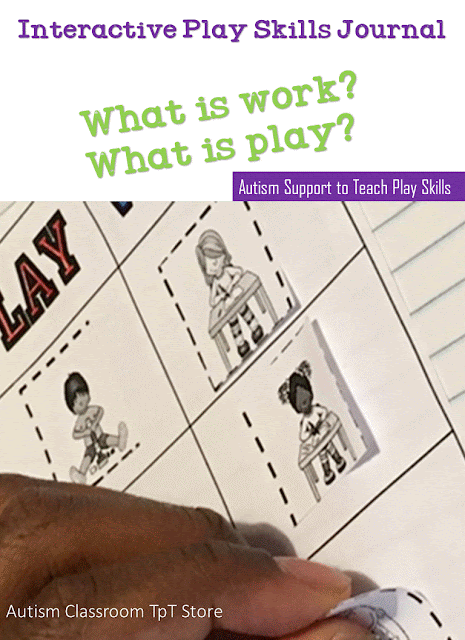
Students can cut and paste the items into their notebooks.  For example, one page has them sort pictures of children working and children playing.


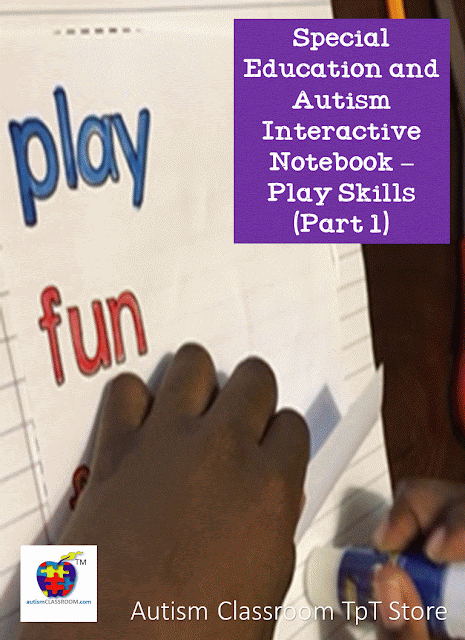
Another activity has students coloring in letters to spell P-L-A-Y, then gluing them inside to make a mini flap book.

Cause and effect is addressed by having students make a flap up foldable.  They choose an animal to open the flap for, and then, the student or the adult make the animal sound.  This can be expanded by writing the name of the animal on the inside of the flap.


Matching is included as well.  For this section of the interactive notebook, the students have to match 4 words related to playing.


While getting there, they work on pasting skills.


They also work on scissor skills during this activity.


Best wishes and have fun playing!!!

Click for here to see the Play Skills Notebook


Mar 12, 2016

Language Based Activities and Printables for Spring

Who is ready for Spring themed lessons?  I think it's time. These language based lessons have a spring theme.  They cover a variety of spring topics including weather, Cinco de Mayo, graduation and others.


There are  printables about flowers as well.  Students can count flowers and select the correct number.  They can also search for the beginning letter "f" as the class discusses the spelling of the word "flower."


I decided to include many activities that have bunnies, butterflies and flowers among other fun spring things that kids like to talk about. In this one, the teacher reads the poem and the student has to cut out the pictures of the bunny and place the bunny high or low when the teacher asks. Teachers can emphasis "high" and "low" before, during and after the activity.

                                             
Don't forget the spring weather bonus file folder game!


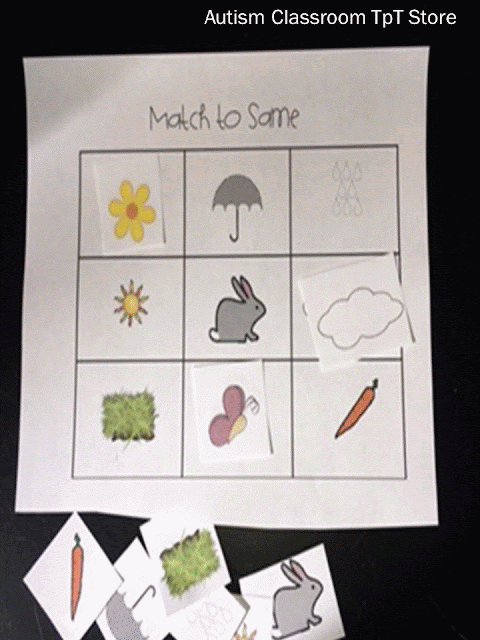
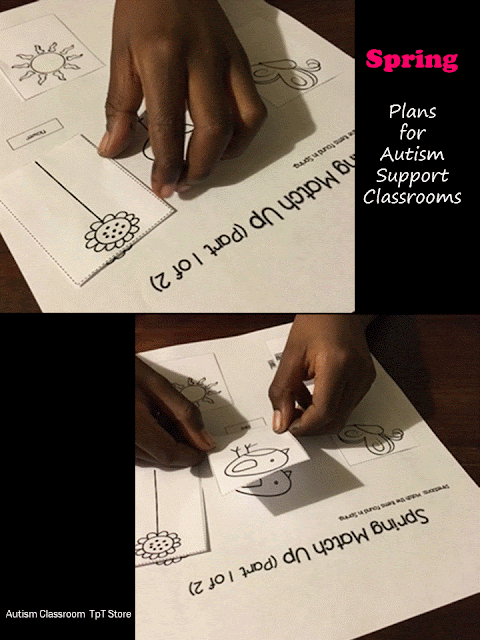
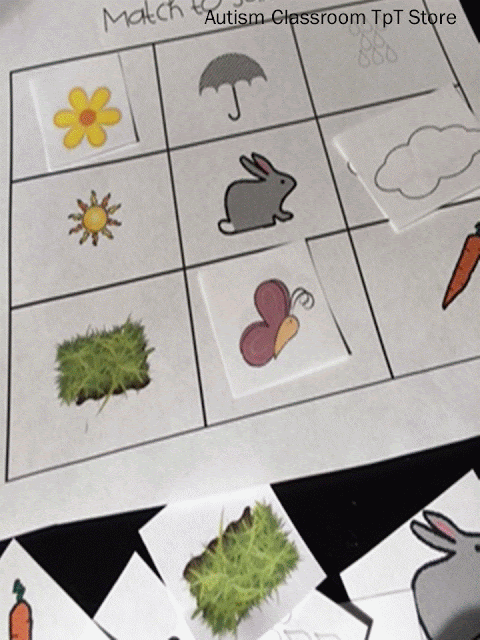
These activities highlight the match to same activities that are in the resource.  Students can practice cutting as well as matching with this task.


https://www.teacherspayteachers.com/Product/Autism-Lesson-Plan-Printables-for-Autism-Support-Classrooms-Spring-1195719

Finally, for June, the printables include pictures that can be colored in and cut out to make a Father's Day card.


The printables are available now.

Spring Lesson Plan Printables


Jul 18, 2014

Autism Characteristics - Communication

Although we know that all individuals with autism are unique and not everyone has the same characteristics, we do know that there are some characteristics that are common in some people with autism.  Communication challenges are well noted in people with autism.  Even if the person is able to speak, some of the non-verbal communication and social interaction can be challenging.  Here is a look at a few things you may notice in the area of communication:
  • Use of gestures or pointing, rather than words. (For some people.)
  • Echolalia (repeating words or phrases). For example, the person might say lines from a movie, commercial or book over and over. 
  • Atypical patterns of speech (learning specific phrases) without much variation to the phrase.
  • Limited interest social interaction for some people. 
  • Limited skills in social interaction even when there is a desire to interact.
  • Limited eye contact for some individuals.
  • Trouble with pragmatics and the social cues and social rules that revolve around language.
  • Ritualistic play patterns (spinning, lining objects) in some children who tend to “play” the same way each time.  This may also be seen in children who tend to be very strict about how the play occurs.
  • Limited joint attention to things that others are attending to.  This is a critical skill because learning most often occurs when you are attending to the same thing as others.


Communication skills (which can be in non-verbal ways) and social skills grow with practice and commitment. It is our responsibility to learn how to become a good communication partner and learn what we can about reaching out to our students and family members with autism.