Showing posts with label teachers. Show all posts

Mar 24, 2016

What to Teach When Teaching Play Skills to a Child with Autism (Play Series Part 3 of 3)

Play can be serious business.  For young children, play is where they learn important concepts and new skills. For some children, this comes easily, and for others, it does not. Sometimes, we have to teach play skills...but where do we even start?  

First, it might help to have the definition of the various types of play.  For example, some types of play are:

Solitary Play- playing without seeming to notice others who may be close by.
Onlooker Play- watching others play, but not participating in the play.
Parallel Play- playing with the same toy or set of toys but not necessarily playing with other children who are nearby.
Cooperative Play- playing with a common goal or a shared activity.
Open-Ended Play- a play activity with various outcomes and no set limits on how to interact with the toy.
Close Ended Play- a play activity with one set outcome or a set expectation of how to play with the item.

Each of these skills can be fostered with a little support and guidance.  Having a plan is essential for knowing what to teach.  Some important elements of that plan are to include what vocabulary to teach, what visual supports to use and various ways to expand the play. 

 Play Skills Interactive Notebook
Play Skills Interactive Notebook (Click on the picture to learn more.)

Additionally, consider these questions when teaching play:

What is this game that is being played?
What is this toy all about?
How does this toy work?
How does this activity go?
Is there a different way to play this game or is there only one way?
What visual supports can help the student understand and communicate during the play period?


The next consideration on what to teach might include teaching techniques that facilitate play.  For one, some students may need help with establishing or adhering to boundaries. This may mean planning to use furniture, rugs, tables, and chairs to help establish boundaries.  Some students have difficulty if they see a large open space.  Sometimes by simply adding a chair and a table you can help them concentrate on the game or toy a little better. Also, just having a rug that serves as a visual reminder of where the toy play can take place could help some.  For example, adults may remind the child, that toys stay in the rug area or that they should sit in this chair when playing this board game.

Another skill to teach during play is communication.  One communication technique may be to include incidental teaching during play to increase communication.  In incidental teaching a teaching scene might look like this:

After the child has approached an activity or object, or has attempted to get the object through a gesture or vocalization, approach the child. Your goal is to require him or her to elicit a more sophisticated response. Attempt to use a 3-level prompt hierarchy for this technique (Mirenda & Iacono I988):
1. Natural Prompt- “”What do you want?” or a questioning look.

2. Minimal Prompt- nonspecific verbal direction. “You need to tell me what you want, say, ‘want ____.”

3. Medium Prompt- request imitation. “You need to tell me what you want; say ‘want ____” and spontaneously sign or point to the communication symbol.  The child must communicate to receive the item.

Other teaching techniques might include floor time, discrete trial teaching, pivotal response training, among others.

Having a support like the Play Skills Interactive Journal may provide guidance and a starting point. It provides ideas on what to teach.  It includes ideas for each of these topics: Imitation, Play Skills, Cause and Effect, Cars and Trucks and Water Vehicles.  It also includes visual supports that can aid with communication during play.

Visual Supports for each play theme. 

Happy Playing!


Mar 20, 2016

Why Structure the Play for Students with Autism? (Play Series Part 2 of 3)

In the last post, the discussion focused on why we should teach play skills to students.  However, it is important to remember to structure the play period for the child. What does structuring your play session accomplish?

For one, it helps establish some clarity for the student.  Clarity makes it easy for them to see what the task is.  Second, structuring the play session helps with the fact that some children have trouble with  organizing.  The adult can organize the play session, prepare the correct materials and serve as a guide for the student. Third, some students with autism have difficulty with sequencing events. Providing visual cues or reminders may help students needing to sequence during play. Using an interactive notebook before the play period to show the sequence of the play skill may help as well. 


This Play Skills Interactive Notebook section focuses on teaching the sequence of steps for playing with cars.    


The student glues in the number strip, then glues in the steps for playing with a car.

Another reason for structuring the play session for students with autism is to teach the rules and directions in a game. It is kind of hard to play a game if you do not know the rules.  Within the structure of the play session, you can teach the rules of the activity or you can review the rules ahead of time, as is shown in the picture below.
 Special Education & Autism Interactive Notebook – Play Skills (Part 1)

Limited imitations skills are another reason to structure play. Students who can imitate are likely to be better at playing and interacting with others. They tend to be watching and learning by doing what others are doing. Some students have not gained this skill, but they can usually gain this skill when taught.  It takes a structured, systematic approach to try to teach this skill. Additionally, as mentioned in the Why Teach Play Skills to Students with Autism post, building joint attention in students who do not currently have joint attention skills is important.  Structuring your play can help teachers and parents to focus on this skill.


Have Fun!!!

Play Skills Interactive Journal


Mar 12, 2016

Language Based Activities and Printables for Spring

Who is ready for Spring themed lessons?  I think it's time. These language based lessons have a spring theme.  They cover a variety of spring topics including weather, Cinco de Mayo, graduation and others.


There are  printables about flowers as well.  Students can count flowers and select the correct number.  They can also search for the beginning letter "f" as the class discusses the spelling of the word "flower."


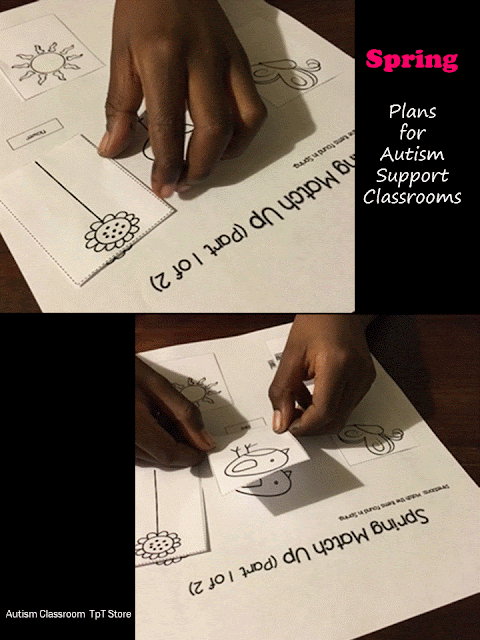
I decided to include many activities that have bunnies, butterflies and flowers among other fun spring things that kids like to talk about. In this one, the teacher reads the poem and the student has to cut out the pictures of the bunny and place the bunny high or low when the teacher asks. Teachers can emphasis "high" and "low" before, during and after the activity.

                                             
Don't forget the spring weather bonus file folder game!


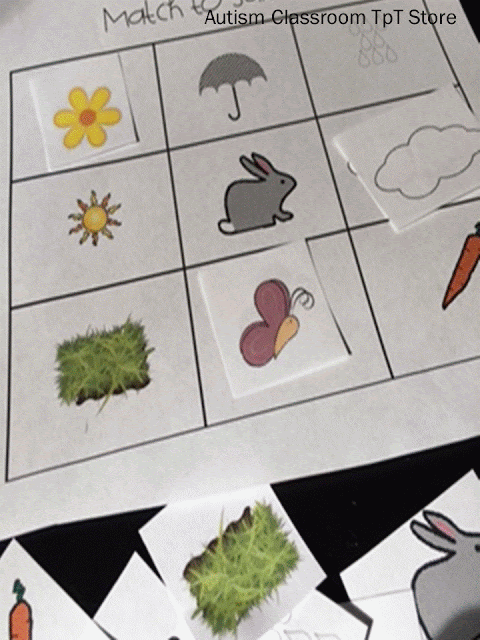
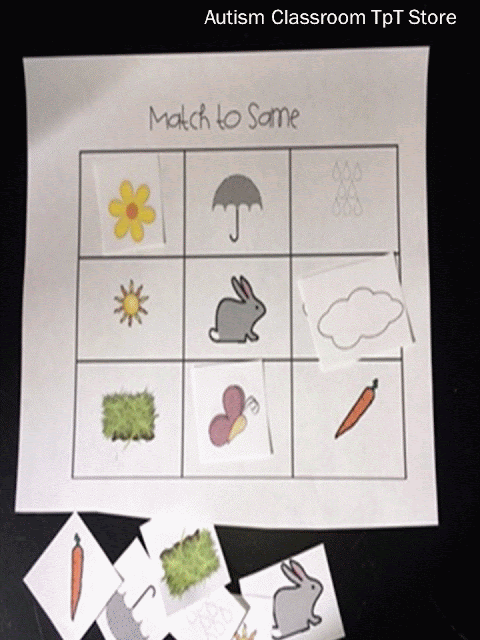
These activities highlight the match to same activities that are in the resource.  Students can practice cutting as well as matching with this task.


https://www.teacherspayteachers.com/Product/Autism-Lesson-Plan-Printables-for-Autism-Support-Classrooms-Spring-1195719

Finally, for June, the printables include pictures that can be colored in and cut out to make a Father's Day card.


The printables are available now.

Spring Lesson Plan Printables


Mar 7, 2016

Looking Forward to Spring with File Folders, Language Lessons and More

File Folder Game: Spring Matching
I am not sure about you, but I am looking forward to Spring.  I like the mild weather and the sun shining more and more in the sky. It is a great time to build some vocabulary skills in our students with motivating real life topics.  Who wouldn't want to learn words like butterfly and frog with a real butterfly or frog sitting there looking at you?  And what is more fun than learning about rain and mud in the real rain and mud?  With that, I decided today to show some of these spring materials that have been hiding for a while. Maybe they can support teaching efforts.  First, there is the
Autism File Folder Games: Spring Matching 


These are a set of file folder games with flowers, umbrellas and raindrops. Super cute images!!!

Next, there is my Spring Picture to Word Match (Match, Trace and Write)

This set includes 16 Spring related sight words and pictures. Each page has 2 cards. Laminate the page, cut the rectangular card and have students:

a. Say or point to the word.
b. Match the correct picture to the word.
c. Trace the word.
d. Write the word.


Also, there is a fun file folder with cute egg designs:  Egg Hunt File Folder


Finally we cannot forget about Autism Lesson Plan Printables for Autism Support and Special Education Classrooms


 Click Image for Link

These lessons include langauge support printables related to: Spring, April, Weather, May, Flowers, Cinco De Mayo, June, Graduation.

The cover has been updated for this resource. The old cover is below.

Former Cover for this Product

Jan 19, 2016

Start the year prepared!!! (A Free Behavior Support Checklist, Making Transitions in the Classroom Easier, Printables for February & More)

Happy New Year!

January is starting out to be a grand month.  Many new things are in store for the new year. Autism Classroom wants to start the year prepared!!!! There are a few new and favorite classroom supports that can help out in January and February.  Let's take a look.


For those of us who work with students who have difficulty with transitions which will...

-Assist smoother transitions with visual supports.
-Clarify time limits and expectations using a visual count down board.
-Make a simple contract with a “First, Then” board.
-Help students tolerate unfavorable activities with the help of a transition bin.
-Use a poster to remind your team to verbally state when a transition will occur.
-Show a topic board with the various activities that will occur during the lesson to help students know when the lesson will be over.


For anyone looking to figure out a strategy to decrease challenging

behaviors, try this FREEBIE:


If you need Printables for Teens with Special Needs:

This one might be more for the teachers than the students.  These are adult
coloring pages with Civil Rights terms and vocabulary:


For those interested in teaching character education, these printables ask

students to 
practice spelling and defining words related to personal

character 
traits:


Also new… Data Binder Covers 


Start the year off prepared.  I hope you have a great January...and February!


Dec 13, 2015

Wandering & Autism: Questions to Aid in Reducing Elopement (Part 3 of 4)

In the previous post, I discussed some general ideas for dealing with in-class elopement for a student who may leave the area, but not leave the classroom.  Today I want to take a look at strategies based on the function of the behavior for students who do try to leave the classroom. We know that wandering, bolting, and fleeing (also know as elopment) can cause stress to a those who care for individuals with autism.  Within the classroom, it may be difficult to pin-point when this behavior will occur, but here are a few things to ask yourself when you are planning a strategy to reduce, remove or react to wandering.


Function:  Eloping for attention


Questions to ask yourself:
1. Have I provided the child with a visual schedule so that they know what is expected during this time.?
2. Have I taught the child how to use the schedule?
3. Are my classroom activities well planned and does the schedule leave out unstructured moments?
4. Is the environment set up with clear visual boundaries?  
5. Did I eliminate using an open space to set up my main teaching area or is it in a cornered area to reduce elopment?
5. Did I use an in task schedule to show the child what to do during this specific activity, how many tasks there will be and when they will be finished?
6. Do I have an adult sitting near the child or keeping an eye out for the child who may possibly  elope?
7.  Is the door closed or childproofed?
8. When they elope for attention, do I respond calmly?
9. When they elope for attention, do I bring them back to the activity by holding their hand and do I eliminate using words so that they do not get my verbal attention?
10. Do I provide attention many times before the elopement so that they get the same amount of energy that elopment usually provides?  Am I successful in teaching them that staying with the group gets excitement and attention but elopement gets a hand held and no conversation?
11. When they elope for attention, am I prepared to find them, hold their hand without conversation and wait quietly (for up to 20 minutes) until they stand up?
12.  Did I create a social narrative or social story about staying with the group?

Function:  Eloping for escape. 


Questions to ask yourself:
1. Have I provided the child with a visual schedule so that they know what is expected during this time.?
2. Have I taught the child how to use the schedule?
3. Are my classroom activities well planned and does the schedule leave out unstructured moments?
4. Is the environment set up with clear visual boundaries?  
5. Did I eliminate using an open space to set up my main teaching area or is it in a cornered area to reduce elopment?
5. Did I use an in task schedule to show the child what to do during this specific activity, how many tasks there will be and when they will be finished?
6. Do I have an adult sitting near the child or keeping an eye out for the child who may possibly  elope?
7.  Is the door closed or childproofed?
8. Do I provide a small box of toys or preferred items during the lesson to encourage them to come to the area and stay in the area?  Am I ok with letting them use the toys for a while (in the area with the group, not off on their own) until they get used to the idea of sitting in that area with others?
9.  Do I give them many choices within activities to keep them engaged throughout the lesson? Am I sure the task is appropriate in relation to time expectations for sitting, and task expectations?
10. Did I teach them how to ask for a break? Did I honor their request? 
11. When they elope for escape, do I respond calmly, but quickly?

12. When they elope for escape, do I have a plan in place to notify key school staff to help locate him/her?
13. When they elope for escape, am I prepared to find them, hold their hand (without conversation) and bring them back to the work area and proceed with the work task without discussion of the elopement?
14.  Did I create a social narrative or social story about staying with the group?
15.  Did I use a token board to teach the child so that they can earn a break? For example, the "I Need a Break Cards" can provide a quick way to facilitate teaching the skill of working for a break.


Function:  Eloping to gain access to something. 


Questions to ask yourself:
1. Have I provided the child with a visual schedule so that they know what is expected during this time?
2. Have I taught the child how to use the schedule?
3. Are my classroom activities well planned and does the schedule leave out unstructured moments?
4. Is the environment set up with clear visual boundaries?  
5. Did I eliminate using an open space to set up my main teaching area or is it in a cornered area to reduce elopment?
5. Did I use an in task schedule to show the child what to do during this specific activity, how many tasks there will be and when they will be finished?
6. Do I have an adult sitting near the child or keeping an eye out for the child who may possibly  elope?
7.  Is the door closed or childproofed?
8. Did I let the child know what time they would gain access to the item or activity they want using a visual support or schedule?
9.  Did I cover or remove the item from the classroom when it is not available?
10. Did I place the access to the item on the students's individualized schedule?
11. Did I teach them how to ask for the item appropriately? Did I honor their request or show them what time it will be available? If it is not an option, did I tell them using a visual support or social story?
12. When they elope for gaining access, do I respond calmly and without words?

13. When they elope for gaining access, do I bring them back to the activity and show them their schedule so that they can begin working again?
14.  Did I use a token board to teach the child that they can earn access to their activity or item? (See an example below.)


Function:  Eloping for sensory input or to avoid sensory input.


Questions to ask yourself:
1. Have I provided the child with a visual schedule so that they know what is expected during this time.?
2. Have I taught the child how to use the schedule?
3. Are my classroom activities well planned and does the schedule leave out unstructured moments?
4. Is the environment set up with clear visual boundaries?  
5. Did I eliminate using an open space to set up my main teaching area or is it in a cornered area to reduce elopment?
5. Did I use an in-task schedule to show the child what to do during this specific activity, how many tasks there will be and when they will be finished?
6. Do I have an adult sitting near the child or keeping an eye out for the child who may possibly  elope?
7.  Is the door closed or childproofed?
8. Did I think about whether or not this activity is too loud, too busy or too overwhelming for the child?
9.  Did I cover or remove the item from the classroom when it is not available?
10. Did I place the access to the item on the student's individualized schedule?
11. Did I ask the Occupational Therapist for help?
12. When they elope for sensory input, do I respond calmly and with support?

13. When they elope for to avoid sensory input, do I respond calmly and with support?
14. When they elope for sensory reasons, do I try to provide the input they are seeking before they elope?  Have I talked to the Occupational Therapist about the possibility of a sensory diet for the student?
15. Did I teach the child how to request the sensory input they seek or how to tell others if something is bothering them?
14.  Did I use a token board to teach the child that they can earn access to their activity or item?

Dec 12, 2015

Wandering & Autism: Elopement with in the Classroom

What if?  There are so many students that will try to elope that it is hard to pinpoint one situation or student for an example. So I am going to go with a "What if" question for this post.  What if I have a student who will not leave the classroom, but will not stay with the group in the area where the rest of the students are working or playing?


This "hypothetical" may be true for many. The first thing to do would be to create clear visual boundaries in the classroom.  Areas of the classroom should be clearly divisible and clearly sectioned off. If there are students prone to leaving the area, be sure to have sturdy furniture that can serve as a physical and visual boundary when possible. Place the furniture in such a way that there is only one entry point to that area of the classroom.  This may mean that the group table no longer sits in the middle of the floor.  It may need to be placed in a corner so that partitions can help provide a physical and visual boundary.

Second, pay attention to seating.  Have an adult sit behind the student during the lesson.  Be sure to have yourself be seated between the student and the door.  Rearrange the table if needed, so that the back of the student's chairs are facing the wall (and very close to the wall) and the teacher is looking towards the wall.  This will allow the wall to serve as one of your physical boundaries. Additionally, think about seating the student in the middle of the group with a peer on each side, in addition to having the back of his/her seat face the wall.  This could make it a little more difficult for him or her to elope.

Third, try to establish the reason or function for the behavior. This step is super important because it lets you know what intervention to try.  If you don't have a good "diagnosis" for the issue, you may end up with a treatment or strategy that does not work. You have to know the function of the behavior to come up with an effective strategy. So think about a few of these questions.
Do they want to get out of doing the work?
Does the activity seem to hurt their ears?
Is there something they are trying to get to instead?
Where do they go when they leave?
Do they just want to play and not know how to tell you?
Are they doing this to gain attention?

Don't worry, if you need a little more insight on the functions of behaviors, check out this free ebook on the topic.


Fourth, make coming to the area fun.  Provide a small container (with a tight lid) of 5 small cause and effect toys or sensory items that are available just for that area. Try placing that on the student's desk before that activity begins.  Allow the student access to the toys only if they sit in the area.  Allow them to interact with the toy they pick while the lesson is occurring.  When it is their turn, have them complete a very small amount of the task, then allow them access to the toy again.  What I always do is to focus the first 3 days on having the student stay in the seat and in the area.  I tend to worry about task completion at a later time. At first it will seem as if they are playing more than working, but this will gradually shift to a situation where the toys are available for the first 1 minute then they are put to the side and available after the task is completed.  However, this takes time. 

On the next blog post I will look at strategies for in-class elopement based on the specific function or the specific reason the student is eloping.

See the previous post on Autism & Wandering here.