Showing posts with label parents. Show all posts

Mar 19, 2016

Why Teach Play Skills to Students with Autism? (Part 1 of 3)


Autism, by definition includes difficulties with social  skills, communication skills and sometimes behavior skills.  Although not everyone with autism has difficulty in all of these areas, each of these areas affects the ability to play.  Joint attention, which is the shared focus on an activity or an object is absent from many younger individuals with autism (until it is taught.)  However, joint attention is needed to learn new skills, to share emotional states, to imitate actions and to learn.  The hope is that if you increase joint attention, you will increase the other skills as well.  One way to increase and teach joint attention in students could be through play.  


I always wondered how I could target the play skills of students in a more structured and focused way. Then, I started to see the increase of teachers using interactive notebooks for topics like reading, science and math.  It dawned on me that this might be a good the way to approach teaching play skills to students with autism.  We already know that most lessons for our students require direct instruction, then practice. So why not for play?  Enter.......the Play Skills Interactive Notebook!!!


This Play Skills Interactive Notebook (Part 1) is made up of activities that are meant to be worked on prior to the play period.  They are meant to build the student's vocabulary and skills related to playing.  After they topics are addressed in the notebook, then it is time to practice the skill in a real structured play situation.  The topics covered in Part 1 are:

Imitation Skills
Play Skills
Cause and Effect
Cars and Trucks
Water Vehicles

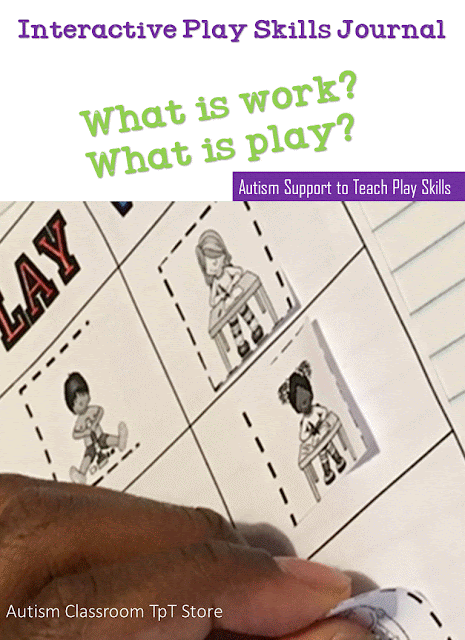
Students can cut and paste the items into their notebooks.  For example, one page has them sort pictures of children working and children playing.


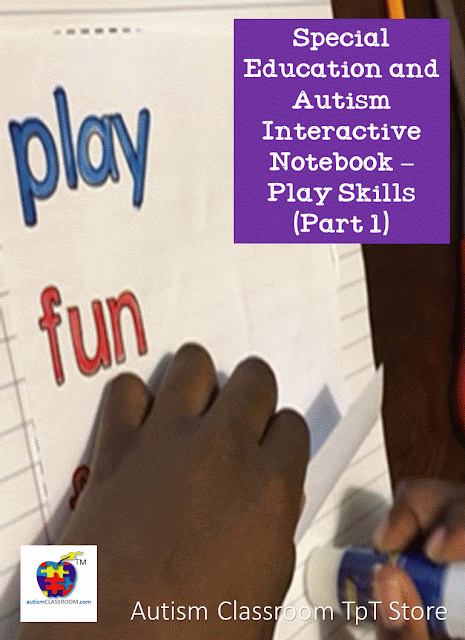
Another activity has students coloring in letters to spell P-L-A-Y, then gluing them inside to make a mini flap book.

Cause and effect is addressed by having students make a flap up foldable.  They choose an animal to open the flap for, and then, the student or the adult make the animal sound.  This can be expanded by writing the name of the animal on the inside of the flap.


Matching is included as well.  For this section of the interactive notebook, the students have to match 4 words related to playing.


While getting there, they work on pasting skills.


They also work on scissor skills during this activity.


Best wishes and have fun playing!!!

Click for here to see the Play Skills Notebook


Dec 15, 2015

Wandering and Autism: Resources for Families

The last few posts have provided suggestions about strategies for wandering and elopement to those in the school setting.  However, elopement occurs in the home and community setting as well.  Here are few bits of information from the AWAARE Collaboration which focuses on providing resources for families that experience wandering. Click on the words to be taken to that site.


Dec 13, 2015

Wandering & Autism: Questions to Aid in Reducing Elopement (Part 3 of 4)

In the previous post, I discussed some general ideas for dealing with in-class elopement for a student who may leave the area, but not leave the classroom.  Today I want to take a look at strategies based on the function of the behavior for students who do try to leave the classroom. We know that wandering, bolting, and fleeing (also know as elopment) can cause stress to a those who care for individuals with autism.  Within the classroom, it may be difficult to pin-point when this behavior will occur, but here are a few things to ask yourself when you are planning a strategy to reduce, remove or react to wandering.


Function:  Eloping for attention


Questions to ask yourself:
1. Have I provided the child with a visual schedule so that they know what is expected during this time.?
2. Have I taught the child how to use the schedule?
3. Are my classroom activities well planned and does the schedule leave out unstructured moments?
4. Is the environment set up with clear visual boundaries?  
5. Did I eliminate using an open space to set up my main teaching area or is it in a cornered area to reduce elopment?
5. Did I use an in task schedule to show the child what to do during this specific activity, how many tasks there will be and when they will be finished?
6. Do I have an adult sitting near the child or keeping an eye out for the child who may possibly  elope?
7.  Is the door closed or childproofed?
8. When they elope for attention, do I respond calmly?
9. When they elope for attention, do I bring them back to the activity by holding their hand and do I eliminate using words so that they do not get my verbal attention?
10. Do I provide attention many times before the elopement so that they get the same amount of energy that elopment usually provides?  Am I successful in teaching them that staying with the group gets excitement and attention but elopement gets a hand held and no conversation?
11. When they elope for attention, am I prepared to find them, hold their hand without conversation and wait quietly (for up to 20 minutes) until they stand up?
12.  Did I create a social narrative or social story about staying with the group?

Function:  Eloping for escape. 


Questions to ask yourself:
1. Have I provided the child with a visual schedule so that they know what is expected during this time.?
2. Have I taught the child how to use the schedule?
3. Are my classroom activities well planned and does the schedule leave out unstructured moments?
4. Is the environment set up with clear visual boundaries?  
5. Did I eliminate using an open space to set up my main teaching area or is it in a cornered area to reduce elopment?
5. Did I use an in task schedule to show the child what to do during this specific activity, how many tasks there will be and when they will be finished?
6. Do I have an adult sitting near the child or keeping an eye out for the child who may possibly  elope?
7.  Is the door closed or childproofed?
8. Do I provide a small box of toys or preferred items during the lesson to encourage them to come to the area and stay in the area?  Am I ok with letting them use the toys for a while (in the area with the group, not off on their own) until they get used to the idea of sitting in that area with others?
9.  Do I give them many choices within activities to keep them engaged throughout the lesson? Am I sure the task is appropriate in relation to time expectations for sitting, and task expectations?
10. Did I teach them how to ask for a break? Did I honor their request? 
11. When they elope for escape, do I respond calmly, but quickly?

12. When they elope for escape, do I have a plan in place to notify key school staff to help locate him/her?
13. When they elope for escape, am I prepared to find them, hold their hand (without conversation) and bring them back to the work area and proceed with the work task without discussion of the elopement?
14.  Did I create a social narrative or social story about staying with the group?
15.  Did I use a token board to teach the child so that they can earn a break? For example, the "I Need a Break Cards" can provide a quick way to facilitate teaching the skill of working for a break.


Function:  Eloping to gain access to something. 


Questions to ask yourself:
1. Have I provided the child with a visual schedule so that they know what is expected during this time?
2. Have I taught the child how to use the schedule?
3. Are my classroom activities well planned and does the schedule leave out unstructured moments?
4. Is the environment set up with clear visual boundaries?  
5. Did I eliminate using an open space to set up my main teaching area or is it in a cornered area to reduce elopment?
5. Did I use an in task schedule to show the child what to do during this specific activity, how many tasks there will be and when they will be finished?
6. Do I have an adult sitting near the child or keeping an eye out for the child who may possibly  elope?
7.  Is the door closed or childproofed?
8. Did I let the child know what time they would gain access to the item or activity they want using a visual support or schedule?
9.  Did I cover or remove the item from the classroom when it is not available?
10. Did I place the access to the item on the students's individualized schedule?
11. Did I teach them how to ask for the item appropriately? Did I honor their request or show them what time it will be available? If it is not an option, did I tell them using a visual support or social story?
12. When they elope for gaining access, do I respond calmly and without words?

13. When they elope for gaining access, do I bring them back to the activity and show them their schedule so that they can begin working again?
14.  Did I use a token board to teach the child that they can earn access to their activity or item? (See an example below.)


Function:  Eloping for sensory input or to avoid sensory input.


Questions to ask yourself:
1. Have I provided the child with a visual schedule so that they know what is expected during this time.?
2. Have I taught the child how to use the schedule?
3. Are my classroom activities well planned and does the schedule leave out unstructured moments?
4. Is the environment set up with clear visual boundaries?  
5. Did I eliminate using an open space to set up my main teaching area or is it in a cornered area to reduce elopment?
5. Did I use an in-task schedule to show the child what to do during this specific activity, how many tasks there will be and when they will be finished?
6. Do I have an adult sitting near the child or keeping an eye out for the child who may possibly  elope?
7.  Is the door closed or childproofed?
8. Did I think about whether or not this activity is too loud, too busy or too overwhelming for the child?
9.  Did I cover or remove the item from the classroom when it is not available?
10. Did I place the access to the item on the student's individualized schedule?
11. Did I ask the Occupational Therapist for help?
12. When they elope for sensory input, do I respond calmly and with support?

13. When they elope for to avoid sensory input, do I respond calmly and with support?
14. When they elope for sensory reasons, do I try to provide the input they are seeking before they elope?  Have I talked to the Occupational Therapist about the possibility of a sensory diet for the student?
15. Did I teach the child how to request the sensory input they seek or how to tell others if something is bothering them?
14.  Did I use a token board to teach the child that they can earn access to their activity or item?

Jul 27, 2015

Do this........Nonverbal imitation for students with autism

Why non-verbal imitation for students with autism?  Simple. We all learn through imitating others.   From the time we are born, we look at what others do and we try it too.  For example, if you walk into a room and see everyone standing, chances are, you would stand too. Some students with autism do not naturally possess this skill.  They may not automatically look to others to find information or answers.  And with this disconnect comes missed opportunity to learn.

This is where the "special"  in special education kicks in. Many students can learn this skill of imitating through focused and direct instruction on imitating.  And, although it may not appear in the student's educational plan, knowing how to imitate has extreme impact on a student's performance in the classroom.

There are a few things to keep in mind when you teach this skill:

1.  It may be easier to begin asking the student to imitate the manipulation of a toy or some other object. It also may be easier if you both have the same identical object. 
2. Next, try working on large motor movements with arms, hands or feet. 
3. Move the imitation request to actions around the room. Be sure the student waits for you to finish the action before they attempt to imitate. 
4. After the student seems to get the hang of this over days, or weeks, add in fine motor imitation.  
5. Students by now may be ready to advance to having you request 2 step then 3 step imitation sequences.

Resources to help teach this skill: 

Action Words, Imitation Skills, & Verb Task Cards for Students with Autism


These task cards provide teachers and para-professionals the words to say and skills to work on to help students perform action word imitation skills.  The cards are designed for classrooms that may have more than one adult working with a student on the skill. They serve as a visual reminder to the adult. This way, everyone stays on the same page. 

Each task card is half a page in size.  They can be laminated to increase durability. On each page, one task card is for Motor Imitation and the other is for Motor Performance. Typically, the motor imitation cards would be taught and mastered before expecting the student to do the motor performance task cards. 


Nov 30, 2014

Shopping with Your Child with Autism

Shopping seems to be an important activity in the month of December.  Whether it is food shopping, toy shopping or just plain old, "I have to pick up one more thing," shopping, we all seem to do a bit more of it during this month. So what strategies can parents and family members try to use to make this experience a tiny bit easier?  What advice can teachers offer families about this subject? Here are a few...

Running Errands

  • Make a visual or written travel schedule, teach it, and use it
  • Use a photo book with various places in it
  • Use their favorite place as the last place before home
  • Have one of their favorite electronic items used only for travel
  • Reserve a special toy for time when the best behavior is needed
  • Keep snacks handy
  • Use headphones for places with large crowds
  • Crete a visual support to show where you are going and when you will be done
Many of these suggestions lean toward helping the child to understand the expectations of the activity.  They do not mean that the child will like what they are hearing.  I know that most kids complain when told of some of the errands they are running. Then they barter with their parents to include some place fun for them.  But the key is that the expectations have be explained.  This is needed as well with children with autism.  However, the plan for the day should be visual and available throughout the entire trip. 

Grocery Shopping

Grocery shopping presents it's own set of challenges. Most people have a history with certain stores and certain behaviors.  This link gives a great story with a very specific technique to try to make that experience smoother. Here are some ways to teach your child to utilize a grocery list, wait in line and handle money. Why?...Because if they can help you shop they are learning a life skill and they have something to concentrate on! Again the key to the grocery shopping might be in the pictures.  This webpage gives pictures to assist in the grocery shopping experience. Even with these ideas, you still need to start small. Don't plan a 3-hour shopping trip just because you have incorporated these techniques. 

Best Wishes!


Jul 17, 2014

Characteristics of Autism: Strengths

Individuals with autism, like all of us, are unique and have their own strengths and difficulties. As parents and teachers we should strive to place emphasis on the strengths while helping the child through the difficulties. This week, let's look at some of the things we know about the characteristics of people with autism.  Today we start with the strengths as highlighted in the book The 1:1 Assistant's Guidebook: Practical Information for Learning Support Aides Working with Students with Autism.