Showing posts with label characteristics. Show all posts

Mar 19, 2016

Why Teach Play Skills to Students with Autism? (Part 1 of 3)


Autism, by definition includes difficulties with social  skills, communication skills and sometimes behavior skills.  Although not everyone with autism has difficulty in all of these areas, each of these areas affects the ability to play.  Joint attention, which is the shared focus on an activity or an object is absent from many younger individuals with autism (until it is taught.)  However, joint attention is needed to learn new skills, to share emotional states, to imitate actions and to learn.  The hope is that if you increase joint attention, you will increase the other skills as well.  One way to increase and teach joint attention in students could be through play.  


I always wondered how I could target the play skills of students in a more structured and focused way. Then, I started to see the increase of teachers using interactive notebooks for topics like reading, science and math.  It dawned on me that this might be a good the way to approach teaching play skills to students with autism.  We already know that most lessons for our students require direct instruction, then practice. So why not for play?  Enter.......the Play Skills Interactive Notebook!!!


This Play Skills Interactive Notebook (Part 1) is made up of activities that are meant to be worked on prior to the play period.  They are meant to build the student's vocabulary and skills related to playing.  After they topics are addressed in the notebook, then it is time to practice the skill in a real structured play situation.  The topics covered in Part 1 are:

Imitation Skills
Play Skills
Cause and Effect
Cars and Trucks
Water Vehicles

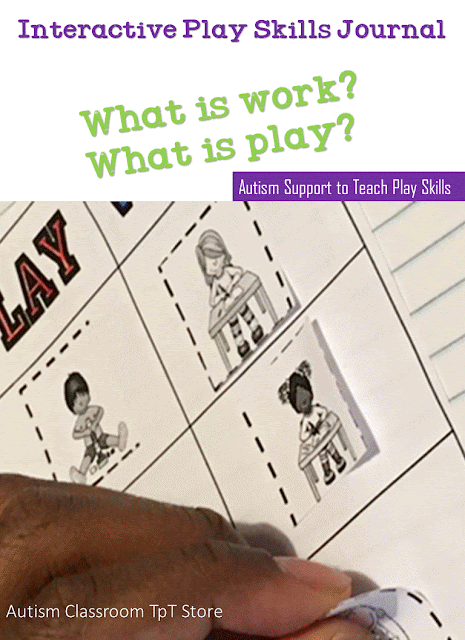
Students can cut and paste the items into their notebooks.  For example, one page has them sort pictures of children working and children playing.


Another activity has students coloring in letters to spell P-L-A-Y, then gluing them inside to make a mini flap book.

Cause and effect is addressed by having students make a flap up foldable.  They choose an animal to open the flap for, and then, the student or the adult make the animal sound.  This can be expanded by writing the name of the animal on the inside of the flap.


Matching is included as well.  For this section of the interactive notebook, the students have to match 4 words related to playing.


While getting there, they work on pasting skills.
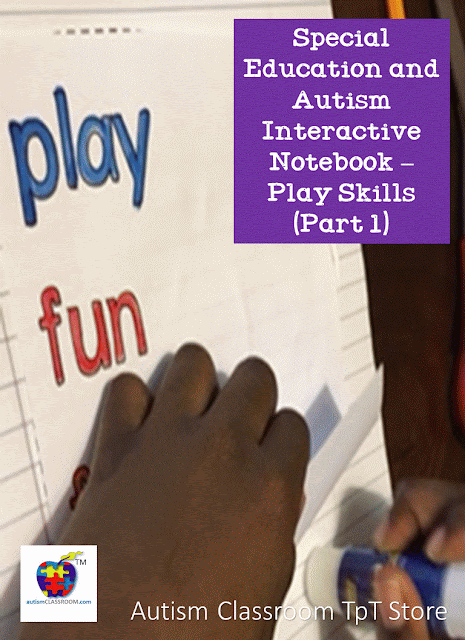

They also work on scissor skills during this activity.


Best wishes and have fun playing!!!

Click for here to see the Play Skills Notebook


Jul 23, 2014

Are You Ready to Be a Leader in Your Field?

Are you really ready to be the leader in your building?  Well, by the nature of the job, you already are the instructional leader in the classroom.  But are you ready to take the leap to being a leader in the building or in your school district?  Maybe you need some ideas of how to make this happen.  Here you go.  So how could you use this Teacher as a Leader series?

  •      You could be the leader in your building
  •      Start a monthly group
  •      Meet weekly with your team for professional development
  •      Schedule a training for the general education faculty
  •      Provide information to parents as part of a newsletter from your classroom
  •      Enhance the training with your own samples and your own task examples


 Teacher as a Leader Part 1

This series makes it easy to step into that role by providing handouts and a PowerPoint that is editable.  The Teacher as a Leader Series Part 1: What is Autism? is perfect if you have people in your building or on your classroom team that are new to working with autism.  It is also helpful if you are leading a discussion group centered around this topic.
 The Teacher as a Leader Part 1


Now that you know how to make this happen, let’s think about the why.  First, there are many new people who join the education field each year.  They come from various backgrounds, some of which do not include professional development in working with students with autism.  Second, it helps you to step up your game when you can confidently explain what it is that you do each day.  Third, our students need you to advocate on their behalf.  Finally, it’s fun once you get started.  

Go be the leader you were born to become!


Jul 18, 2014

Autism Characteristics - Communication

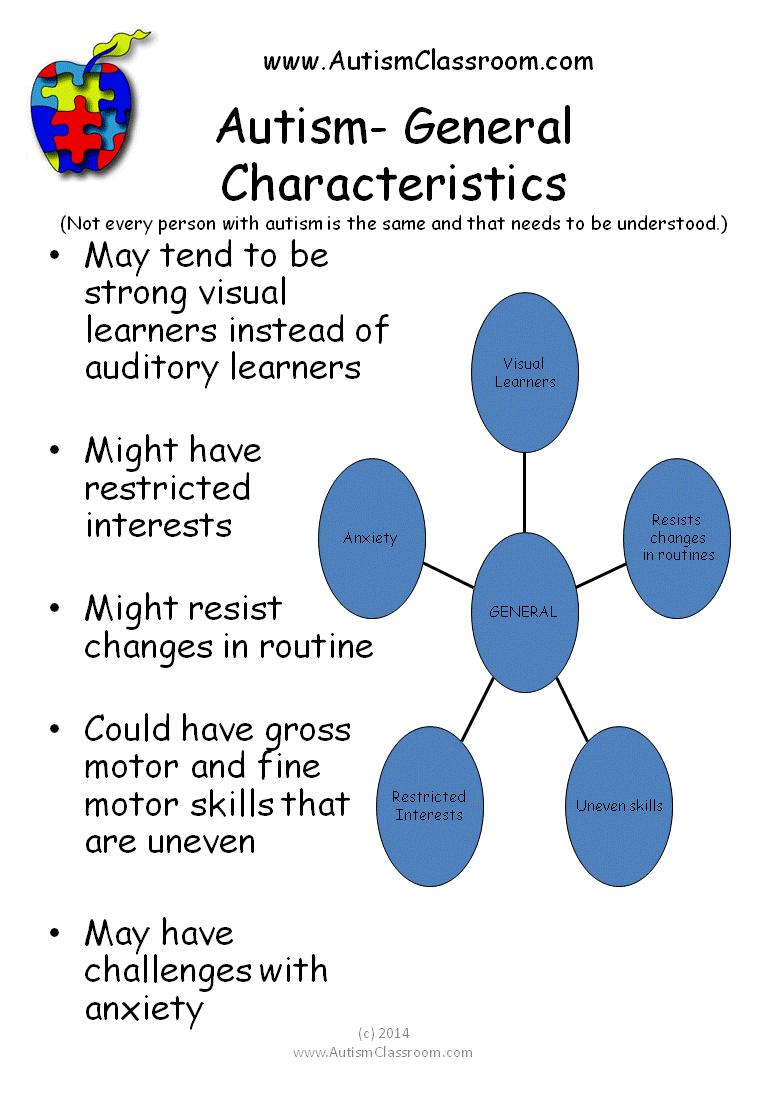
Although we know that all individuals with autism are unique and not everyone has the same characteristics, we do know that there are some characteristics that are common in some people with autism.  Communication challenges are well noted in people with autism.  Even if the person is able to speak, some of the non-verbal communication and social interaction can be challenging.  Here is a look at a few things you may notice in the area of communication:
  • Use of gestures or pointing, rather than words. (For some people.)
  • Echolalia (repeating words or phrases). For example, the person might say lines from a movie, commercial or book over and over. 
  • Atypical patterns of speech (learning specific phrases) without much variation to the phrase.
  • Limited interest social interaction for some people. 
  • Limited skills in social interaction even when there is a desire to interact.
  • Limited eye contact for some individuals.
  • Trouble with pragmatics and the social cues and social rules that revolve around language.
  • Ritualistic play patterns (spinning, lining objects) in some children who tend to “play” the same way each time.  This may also be seen in children who tend to be very strict about how the play occurs.
  • Limited joint attention to things that others are attending to.  This is a critical skill because learning most often occurs when you are attending to the same thing as others.


Communication skills (which can be in non-verbal ways) and social skills grow with practice and commitment. It is our responsibility to learn how to become a good communication partner and learn what we can about reaching out to our students and family members with autism. 


Jul 17, 2014

Characteristics of Autism: Strengths

Individuals with autism, like all of us, are unique and have their own strengths and difficulties. As parents and teachers we should strive to place emphasis on the strengths while helping the child through the difficulties. This week, let's look at some of the things we know about the characteristics of people with autism.  Today we start with the strengths as highlighted in the book The 1:1 Assistant's Guidebook: Practical Information for Learning Support Aides Working with Students with Autism.