Showing posts with label social skills. Show all posts

Mar 24, 2016

What to Teach When Teaching Play Skills to a Child with Autism (Play Series Part 3 of 3)

Play can be serious business.  For young children, play is where they learn important concepts and new skills. For some children, this comes easily, and for others, it does not. Sometimes, we have to teach play skills...but where do we even start?  

First, it might help to have the definition of the various types of play.  For example, some types of play are:

Solitary Play- playing without seeming to notice others who may be close by.
Onlooker Play- watching others play, but not participating in the play.
Parallel Play- playing with the same toy or set of toys but not necessarily playing with other children who are nearby.
Cooperative Play- playing with a common goal or a shared activity.
Open-Ended Play- a play activity with various outcomes and no set limits on how to interact with the toy.
Close Ended Play- a play activity with one set outcome or a set expectation of how to play with the item.

Each of these skills can be fostered with a little support and guidance.  Having a plan is essential for knowing what to teach.  Some important elements of that plan are to include what vocabulary to teach, what visual supports to use and various ways to expand the play. 

 Play Skills Interactive Notebook
Play Skills Interactive Notebook (Click on the picture to learn more.)

Additionally, consider these questions when teaching play:

What is this game that is being played?
What is this toy all about?
How does this toy work?
How does this activity go?
Is there a different way to play this game or is there only one way?
What visual supports can help the student understand and communicate during the play period?


The next consideration on what to teach might include teaching techniques that facilitate play.  For one, some students may need help with establishing or adhering to boundaries. This may mean planning to use furniture, rugs, tables, and chairs to help establish boundaries.  Some students have difficulty if they see a large open space.  Sometimes by simply adding a chair and a table you can help them concentrate on the game or toy a little better. Also, just having a rug that serves as a visual reminder of where the toy play can take place could help some.  For example, adults may remind the child, that toys stay in the rug area or that they should sit in this chair when playing this board game.

Another skill to teach during play is communication.  One communication technique may be to include incidental teaching during play to increase communication.  In incidental teaching a teaching scene might look like this:

After the child has approached an activity or object, or has attempted to get the object through a gesture or vocalization, approach the child. Your goal is to require him or her to elicit a more sophisticated response. Attempt to use a 3-level prompt hierarchy for this technique (Mirenda & Iacono I988):
1. Natural Prompt- “”What do you want?” or a questioning look.

2. Minimal Prompt- nonspecific verbal direction. “You need to tell me what you want, say, ‘want ____.”

3. Medium Prompt- request imitation. “You need to tell me what you want; say ‘want ____” and spontaneously sign or point to the communication symbol.  The child must communicate to receive the item.

Other teaching techniques might include floor time, discrete trial teaching, pivotal response training, among others.

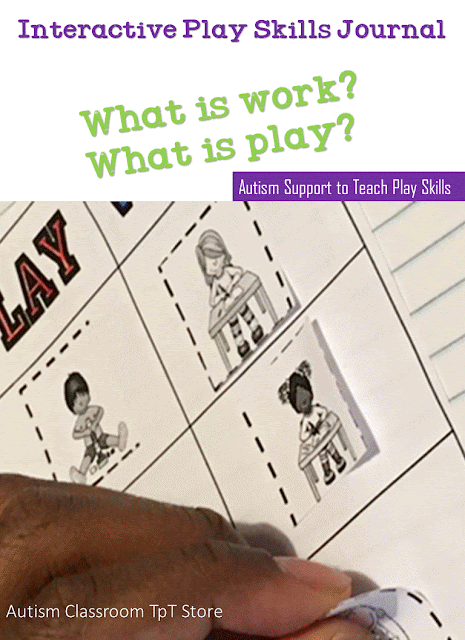
Having a support like the Play Skills Interactive Journal may provide guidance and a starting point. It provides ideas on what to teach.  It includes ideas for each of these topics: Imitation, Play Skills, Cause and Effect, Cars and Trucks and Water Vehicles.  It also includes visual supports that can aid with communication during play.

Visual Supports for each play theme. 

Happy Playing!


Mar 19, 2016

Why Teach Play Skills to Students with Autism? (Part 1 of 3)


Autism, by definition includes difficulties with social  skills, communication skills and sometimes behavior skills.  Although not everyone with autism has difficulty in all of these areas, each of these areas affects the ability to play.  Joint attention, which is the shared focus on an activity or an object is absent from many younger individuals with autism (until it is taught.)  However, joint attention is needed to learn new skills, to share emotional states, to imitate actions and to learn.  The hope is that if you increase joint attention, you will increase the other skills as well.  One way to increase and teach joint attention in students could be through play.  


I always wondered how I could target the play skills of students in a more structured and focused way. Then, I started to see the increase of teachers using interactive notebooks for topics like reading, science and math.  It dawned on me that this might be a good the way to approach teaching play skills to students with autism.  We already know that most lessons for our students require direct instruction, then practice. So why not for play?  Enter.......the Play Skills Interactive Notebook!!!


This Play Skills Interactive Notebook (Part 1) is made up of activities that are meant to be worked on prior to the play period.  They are meant to build the student's vocabulary and skills related to playing.  After they topics are addressed in the notebook, then it is time to practice the skill in a real structured play situation.  The topics covered in Part 1 are:

Imitation Skills
Play Skills
Cause and Effect
Cars and Trucks
Water Vehicles

Students can cut and paste the items into their notebooks.  For example, one page has them sort pictures of children working and children playing.


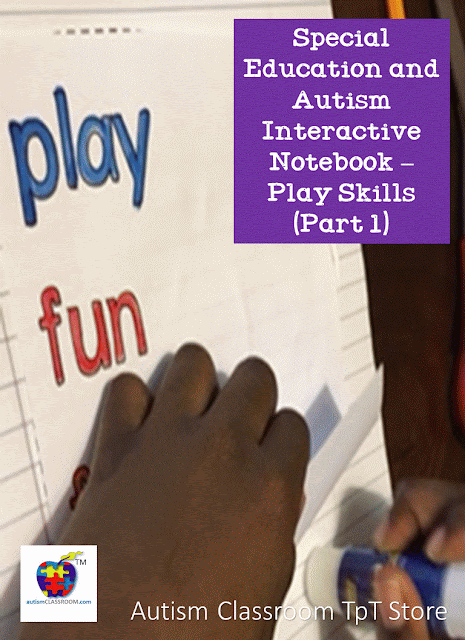
Another activity has students coloring in letters to spell P-L-A-Y, then gluing them inside to make a mini flap book.

Cause and effect is addressed by having students make a flap up foldable.  They choose an animal to open the flap for, and then, the student or the adult make the animal sound.  This can be expanded by writing the name of the animal on the inside of the flap.


Matching is included as well.  For this section of the interactive notebook, the students have to match 4 words related to playing.


While getting there, they work on pasting skills.


They also work on scissor skills during this activity.


Best wishes and have fun playing!!!

Click for here to see the Play Skills Notebook


Aug 2, 2015

Day 1: Bundles, Behavior, Colors, Posters, File Folders and a Game Plan (How to Shop an Autism Classroom TpT Back to School Sale)

Hey Everyone. It is finally that time of year.  The huge Teachers Pay Teachers Sale will be on Monday and Tuesday (August 3rd and 4th) at the Autism Classroom TpT Store. Teachers can experience up to 28% off of original prices by using the promo code BTS15 at checkout. In order to be fully prepared, I want to use these next three days to highlight the resources in the Autism Classroom store and establish a game plan.


How to shop this Autism Classroom TpT sale:

Sunday

Join for free to be a member of Teachers Pay Teachers (here.)  This will allow you to access free content on the site. Next, go to the freebies section of the store (here) and download the freebies that are in the store. This will give you an idea of the types of products available.  It will also help you to see if these are items you may be interested in purchasing.  Some of the free items are lessons for August, so you will will also be gaining valuable materials that you do not have to spend time making for the first few days of school, when you need your time the most.

Sunday Afternoon

After looking through the freebies from the store and deciding that you may want to investigate a little further, go back to the Autism Classroom Store (here).  This time, add items to your "wish list" or to your cart (you can remove them at any time before purchase.)  This way you will have a running list of the items you want to get or might like to get in the future.  Also, you can spend the time on the weekend to research and then on Monday just purchase what you already picked out.

Sunday Night

Make some decisions about the specific materials that you want to purchase and get ready to have a ball !!!!!

Use the hashtag #AtAutismClassroomTpTStore to show me all of the items on your wish list, in your cart or great stuff you already bought.

Now Lets Take a Look at a Few Items

Today, Monday and Tuesday, I will list the products by category.  Sometimes it is easier to see them all in a list rather that surfing through the website. So here it goes...


MEGA BUNDLE (Limited Time Only)


Free Behavior Support Posters


Certificates & Posters

I Will Try Statements
Growth Mindset Posters


·         Autism


My Color Book


·         Easter File Folder
          

·         Summer Fun File Folder Games


·         Tablet Fun File Folder Games


Aug 16, 2014

I Need a Break! Break Cards for Students with Limited Speech

Once you have created your lovely schedules for your students and you have yous lesson plans all ready to go, all of you students with sit down follow the schedule and have no behavior challenges throughout the entire school day.

WRONG.

Behavior challenges will occur even with super structure and organization.  The more consistent you are in providing the right routines, then those behavior will be minimized. But what if a student wants to take a break and they have no words?  What will they do?  They will get up, they will make a game of it, they will fall to the floor, they may hit, they may throw things, they may put their head down.  Then list is endless.

If you want to create a voice for a student who may not yet have speech or who may not always be able to pull out the words they want to say, try using break cards.  With a break card, the student can tell the adult "I need  a break."
 Break Cards on TpT

Only one type of card is need.  Just choose the one you prefer. There is also a "working for" card in where the student can earn a certain amount of "tokens" in order to earn the break. They can be laminated and used for the entire school year.   

Jul 18, 2014

Autism Characteristics - Communication

Although we know that all individuals with autism are unique and not everyone has the same characteristics, we do know that there are some characteristics that are common in some people with autism.  Communication challenges are well noted in people with autism.  Even if the person is able to speak, some of the non-verbal communication and social interaction can be challenging.  Here is a look at a few things you may notice in the area of communication:
  • Use of gestures or pointing, rather than words. (For some people.)
  • Echolalia (repeating words or phrases). For example, the person might say lines from a movie, commercial or book over and over. 
  • Atypical patterns of speech (learning specific phrases) without much variation to the phrase.
  • Limited interest social interaction for some people. 
  • Limited skills in social interaction even when there is a desire to interact.
  • Limited eye contact for some individuals.
  • Trouble with pragmatics and the social cues and social rules that revolve around language.
  • Ritualistic play patterns (spinning, lining objects) in some children who tend to “play” the same way each time.  This may also be seen in children who tend to be very strict about how the play occurs.
  • Limited joint attention to things that others are attending to.  This is a critical skill because learning most often occurs when you are attending to the same thing as others.


Communication skills (which can be in non-verbal ways) and social skills grow with practice and commitment. It is our responsibility to learn how to become a good communication partner and learn what we can about reaching out to our students and family members with autism.