Showing posts with label scissors. Show all posts

Mar 19, 2016

Why Teach Play Skills to Students with Autism? (Part 1 of 3)


Autism, by definition includes difficulties with social  skills, communication skills and sometimes behavior skills.  Although not everyone with autism has difficulty in all of these areas, each of these areas affects the ability to play.  Joint attention, which is the shared focus on an activity or an object is absent from many younger individuals with autism (until it is taught.)  However, joint attention is needed to learn new skills, to share emotional states, to imitate actions and to learn.  The hope is that if you increase joint attention, you will increase the other skills as well.  One way to increase and teach joint attention in students could be through play.  


I always wondered how I could target the play skills of students in a more structured and focused way. Then, I started to see the increase of teachers using interactive notebooks for topics like reading, science and math.  It dawned on me that this might be a good the way to approach teaching play skills to students with autism.  We already know that most lessons for our students require direct instruction, then practice. So why not for play?  Enter.......the Play Skills Interactive Notebook!!!


This Play Skills Interactive Notebook (Part 1) is made up of activities that are meant to be worked on prior to the play period.  They are meant to build the student's vocabulary and skills related to playing.  After they topics are addressed in the notebook, then it is time to practice the skill in a real structured play situation.  The topics covered in Part 1 are:

Imitation Skills
Play Skills
Cause and Effect
Cars and Trucks
Water Vehicles

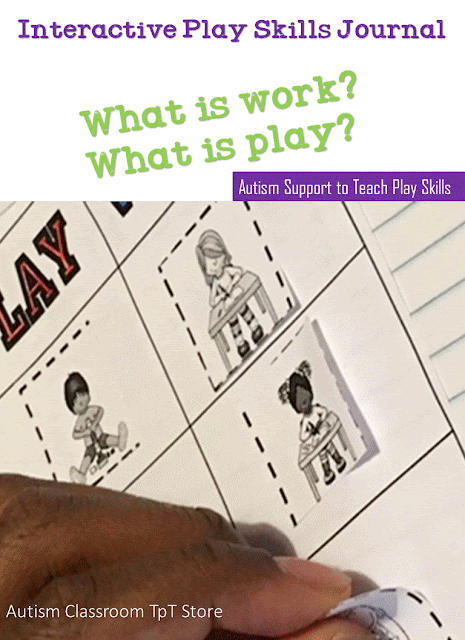
Students can cut and paste the items into their notebooks.  For example, one page has them sort pictures of children working and children playing.


Another activity has students coloring in letters to spell P-L-A-Y, then gluing them inside to make a mini flap book.

Cause and effect is addressed by having students make a flap up foldable.  They choose an animal to open the flap for, and then, the student or the adult make the animal sound.  This can be expanded by writing the name of the animal on the inside of the flap.


Matching is included as well.  For this section of the interactive notebook, the students have to match 4 words related to playing.


While getting there, they work on pasting skills.
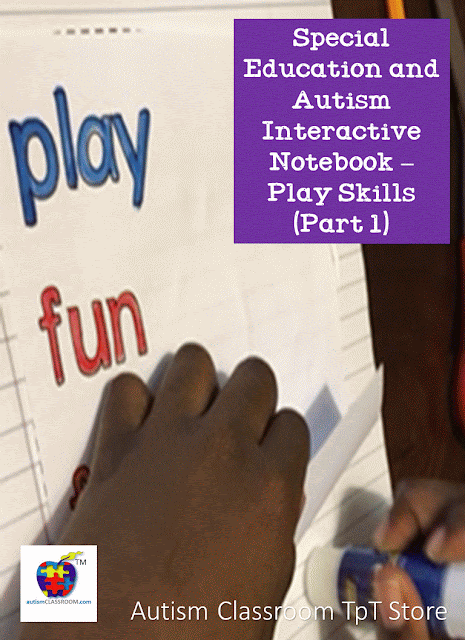

They also work on scissor skills during this activity.


Best wishes and have fun playing!!!

Click for here to see the Play Skills Notebook


Jul 23, 2015

Scissor Skills Sequence and Adapted Scissors for Students Learning Fine Motor Skills

Early this week, I wrote about fine motor skills related to writing.  We also know that our students sometimes have trouble with cutting and scissor skills.  Obviously, first, we have to teach scissor safety so that kids are not endangering themselves and others. For some students, this may mean that you stay close to them at all times when using scissors.  For others, it may mean starting with plastic safety scissors.  Still others might simply need to know what to with the scissors and they can take it form there. 

When I work with students to increase scissor skills, I use a variety of scissor types.  For example, for students who really have safety as an issue, I might use an "ultra safe" kids scissors product.  For students who can close the scissors, but might have a hard time opening then, I might use an "easy spring" scissor product because it automatically springs back into action.  Additionally, I like the scissors that allow for all four of the students fingers to go in the bottom hole and the thumb at the top so that they have somewhere to place their fingers while cutting.  And.......I cannot say enough about the combo pair with all of these innovations in one!


Teaching Scissor Skills

Once you have decided what tool to use, it is time to begin teaching the skill.  First, assess what the student already knows about cutting paper.  Some kids know to place the scissors up to the paper and some do not. After you get your starting point, teach that skill.  For many starting out, the first step is to make small snips in paper. These can be without lines for the student to cut specifically or you could give them a visual cue of where to cut. If paper is to flimsy, try an index card for making snips in paper.

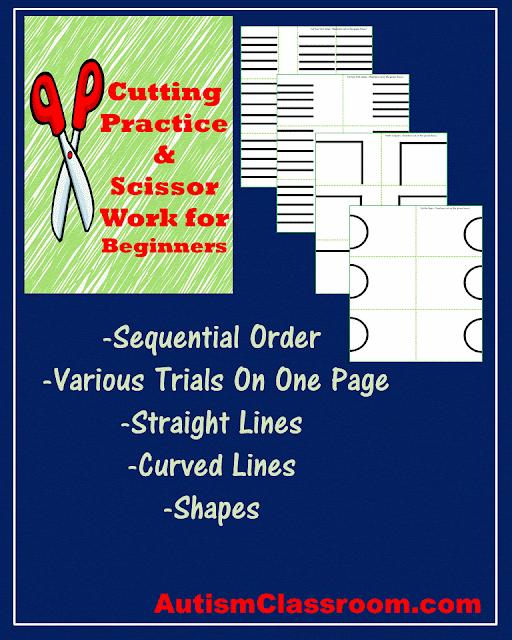
The resource called Cutting Practice and Scissor Work for Beginners provides handouts with sequenced steps for scissor work.  

Most pages contain several trials of the skill on one page.  


The resource also includes lines, curves, and shapes.

                                                     Click for More Information

The steps to cutting the square is broken down into parts.  First, the student will need to cut a straight line to "cut a square" shape. You set it up so that after they finish, they have a square.  Next, you provide them with just an L shaped line, so that after they cut the L-shaped line, they have a square. Third, you give them a square with 3 lines to cut. After they have mastered all of these, you can give them the full square to cut. For some students, this task is easier if you use card stock paper which is not as flimsy as regular copy paper. 

If you need to teach this skill, give these tips a try.  Bring lots of patience. Have fun!