Showing posts with label tasks. Show all posts

May 9, 2016

Are you Teaching in a Special Education Class or at a Special Needs Camp This Summer?

Sometimes teachers will make a change during the summer and work at a summer camp or work in a special needs classroom for the summer.  When they do, they usually have a great and rewarding experience.  The time is getting closer, so I thought I would provide a few tips for teaching in a special education classroom or at a camp for students with special needs for the summer.  

  1.       Be sure to prepare. Have a plan in place for lessons and activities.
  2.       Read the background information about your students or campers.
  3.       Call or visit the current teacher and paraprofessionals before the school year is out. Ask them for specific strategies and techniques that may work with each student.
  4.       Read over any behavior plans for students.
  5.       Find out the location of resource materials for specific students who need them.  For example, if a student uses a communication book, find out where it will be located during the summer.  Or, if the behavior plan says a student uses a checklist to complete their work, find out where you can get access to the checklist.
  6.      Set up the space to include small group activities.  Small groups can provide more individualized attention to students and provides movement for them as well, as they move from group to group. 
  7.      Practice the skill of “never letting them see you sweat.” Mishaps will happen in the classroom or at a camp, but try to remain calm and be the voice of reason in each situation.
  8.       The voice of reason is sometimes quiet.  Some kids need quiet and peace to help them calm down and defuse a situation.
  9.       Have fun. A little shaving cream, bubbles and water play in the summer goes a long way!


Here is a list of the summer products and resources available at the Autism Classroom Teachers Pay Teachers store.  The first few are directly related to summer.  The last few are freebies that could be used year round.  Spread the word.  Enjoy.


Apr 3, 2016

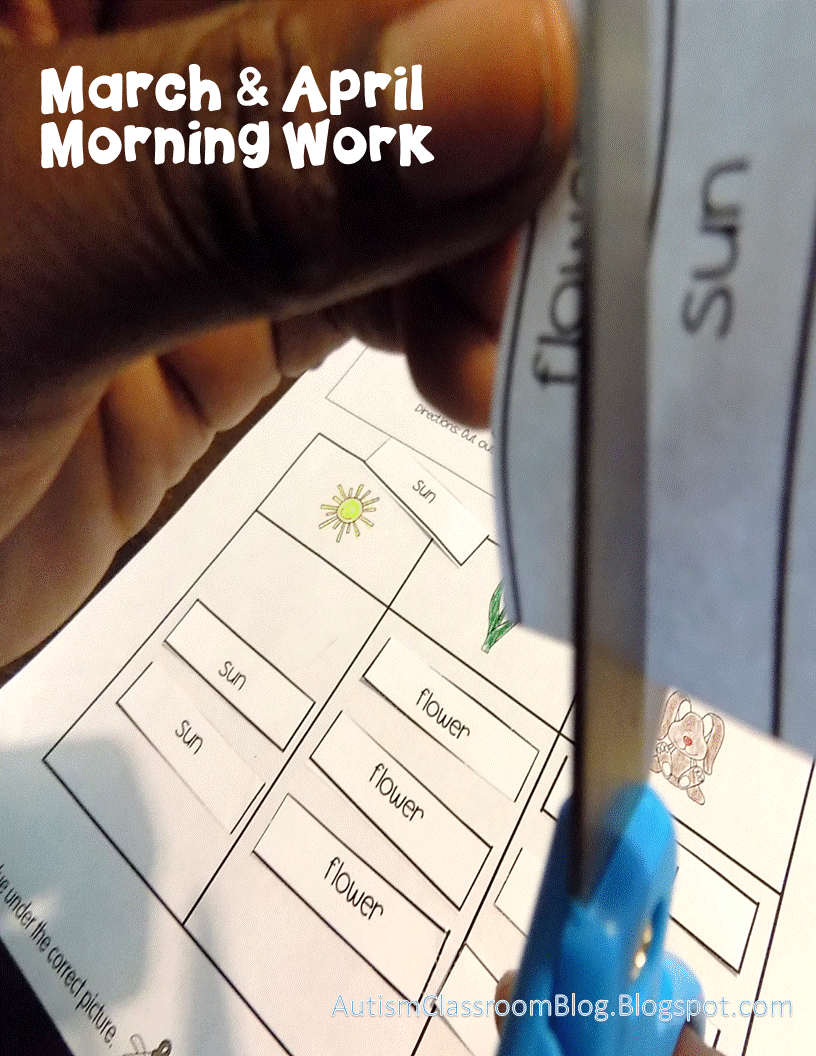
Spring is Here: A Peek Inside of the Morning Work for March and April

I was really hoping to say it is Spring and the weather is beginning to feel great, but, today feels colder than most typical winter days around here. However, it is time to start exploring the March and April Morning Work.  As you can see it is filled with pictures of sunshine, flowers and rainbows.  I just hope after a day or two the weather lives up to it.  Let's take a look.


As usual, the Morning Work for Students with Autism provides hands-on activities for students.  This March and April edition is no different. Here students can complete a task related to spring related words. 


They can cut the items themselves, or you can have the items pre-cut for them.


Keep their  hands busy and keep them focused.


They can work on reading, cutting, gluing, matching and coloring skills all at once.


This activity was fun.


Next, there is a page on descriptive words where the student can match the phrase to the picture.


And, what would a spring resource be without a rainbow?  On this page, they simply color in the rainbow, then draw a line to match the individual letters in the word "spring."


Pin ME!
The page with "Wh" questions provides an opportunity for students to show what they know about spring weather.


These work great for students with limited handwriting skills, young students and those with special needs.  They can still practice skills and show what they know without the requirement of too much writing.


Enjoy your Spring!!!


 March and April Morning Work
Click here for the March and April Morning Work 


Mar 20, 2016

Why Structure the Play for Students with Autism? (Play Series Part 2 of 3)

In the last post, the discussion focused on why we should teach play skills to students.  However, it is important to remember to structure the play period for the child. What does structuring your play session accomplish?

For one, it helps establish some clarity for the student.  Clarity makes it easy for them to see what the task is.  Second, structuring the play session helps with the fact that some children have trouble with  organizing.  The adult can organize the play session, prepare the correct materials and serve as a guide for the student. Third, some students with autism have difficulty with sequencing events. Providing visual cues or reminders may help students needing to sequence during play. Using an interactive notebook before the play period to show the sequence of the play skill may help as well. 


This Play Skills Interactive Notebook section focuses on teaching the sequence of steps for playing with cars.    


The student glues in the number strip, then glues in the steps for playing with a car.

Another reason for structuring the play session for students with autism is to teach the rules and directions in a game. It is kind of hard to play a game if you do not know the rules.  Within the structure of the play session, you can teach the rules of the activity or you can review the rules ahead of time, as is shown in the picture below.
 Special Education & Autism Interactive Notebook – Play Skills (Part 1)

Limited imitations skills are another reason to structure play. Students who can imitate are likely to be better at playing and interacting with others. They tend to be watching and learning by doing what others are doing. Some students have not gained this skill, but they can usually gain this skill when taught.  It takes a structured, systematic approach to try to teach this skill. Additionally, as mentioned in the Why Teach Play Skills to Students with Autism post, building joint attention in students who do not currently have joint attention skills is important.  Structuring your play can help teachers and parents to focus on this skill.


Have Fun!!!

Play Skills Interactive Journal


Jan 19, 2016

Start the year prepared!!! (A Free Behavior Support Checklist, Making Transitions in the Classroom Easier, Printables for February & More)

Happy New Year!

January is starting out to be a grand month.  Many new things are in store for the new year. Autism Classroom wants to start the year prepared!!!! There are a few new and favorite classroom supports that can help out in January and February.  Let's take a look.


For those of us who work with students who have difficulty with transitions which will...

-Assist smoother transitions with visual supports.
-Clarify time limits and expectations using a visual count down board.
-Make a simple contract with a “First, Then” board.
-Help students tolerate unfavorable activities with the help of a transition bin.
-Use a poster to remind your team to verbally state when a transition will occur.
-Show a topic board with the various activities that will occur during the lesson to help students know when the lesson will be over.


For anyone looking to figure out a strategy to decrease challenging

behaviors, try this FREEBIE:


If you need Printables for Teens with Special Needs:

This one might be more for the teachers than the students.  These are adult
coloring pages with Civil Rights terms and vocabulary:


For those interested in teaching character education, these printables ask

students to 
practice spelling and defining words related to personal

character 
traits:


Also new… Data Binder Covers 


Start the year off prepared.  I hope you have a great January...and February!


Jul 27, 2015

Do this........Nonverbal imitation for students with autism

Why non-verbal imitation for students with autism?  Simple. We all learn through imitating others.   From the time we are born, we look at what others do and we try it too.  For example, if you walk into a room and see everyone standing, chances are, you would stand too. Some students with autism do not naturally possess this skill.  They may not automatically look to others to find information or answers.  And with this disconnect comes missed opportunity to learn.

This is where the "special"  in special education kicks in. Many students can learn this skill of imitating through focused and direct instruction on imitating.  And, although it may not appear in the student's educational plan, knowing how to imitate has extreme impact on a student's performance in the classroom.

There are a few things to keep in mind when you teach this skill:

1.  It may be easier to begin asking the student to imitate the manipulation of a toy or some other object. It also may be easier if you both have the same identical object. 
2. Next, try working on large motor movements with arms, hands or feet. 
3. Move the imitation request to actions around the room. Be sure the student waits for you to finish the action before they attempt to imitate. 
4. After the student seems to get the hang of this over days, or weeks, add in fine motor imitation.  
5. Students by now may be ready to advance to having you request 2 step then 3 step imitation sequences.

Resources to help teach this skill: 

Action Words, Imitation Skills, & Verb Task Cards for Students with Autism


These task cards provide teachers and para-professionals the words to say and skills to work on to help students perform action word imitation skills.  The cards are designed for classrooms that may have more than one adult working with a student on the skill. They serve as a visual reminder to the adult. This way, everyone stays on the same page. 

Each task card is half a page in size.  They can be laminated to increase durability. On each page, one task card is for Motor Imitation and the other is for Motor Performance. Typically, the motor imitation cards would be taught and mastered before expecting the student to do the motor performance task cards. 


Mar 22, 2015

Exploring Morning Work for March and April for Students with Special Needs

Finding lessons that are appropriate and meaningful for students is a balancing act teachers deal with each day. Although many teachers love to include morning work activities in the school day, sometimes the task is not suitable for students with autism.  There could be a number or reasons.  For example, maybe handwriting is a challenge or maybe the student cannot handle too many items on the page.  For whatever reason, some worksheets may not work with the student. That is why I am loving these morning work for students with autism packets. 

For one, they may work great for K, 1st and 2nd grade or students whose special needs include developmental delays.   However, they are great for pre-k too.  Secondly, they include printable worksheets that require variations in response styles for many answers.  So if a student is having trouble with writing, they will have options to show what they know without writing.  Some examples include, using string to match items, cutting and pasting answers, using  bingo markers, coloring and circling answers.

There are a number of things I like about the March and April pack.


1. There is a  simple page recognizing Women,s History Month.  This page gives your kiddos practice cutting straight lines and matching to same. 


2. There is a page highlighting the spelling of the work March.  I like it because it focuses on teh work March with easy to do tasks such as using a bingo marker and tracing. 

3. Stepping into April, it has an April Fool's Day page with a joke for students to tell.  They can tell this joke using pictures. Students can point to the picutures to tell the joke if they cannot use words.  This is a great way to introduce the "give and take" skill in conversations and the concept of telling a joke.  How cool it that?


4. And finally, and most importantly, (to me), it talks about Spring! Maybe discussion about Spring will bring the Spring weather.  So, the April Part of the packet covers this.  If you want to discuss Spring and have the students practice cutting and matching pictures to the same picture, then this will do the job. 


Dec 28, 2014

Fine Motor Imitation Skills for Children with Autism

I have been working on materials that address fine motor skills in students.  For some of our students, this can be a real challenge. A few students may have scattered skills in this area.  There is a typical sequence that you can follow to get some motor imitation from your students.  This sequence seems to work: gross motor imitation, fine motor imitation, imitation of nonsense sounds, imitation of animal sounds, imitation of speech sounds and words.  It may be best to chose the skill you want to work on and the materials that you want to utilize. Next, work on that skill using a strong reinforcing item. However, in reality, many children might need guided assistance to correctly imitate a skill. (You don't want them to develop the skill incorrectly- for example writing a letter incorrectly.) Then, you can fade your assistance over time, as they do the skill better and better.

I usually like to have students trace first to have practice with  the actual line or shape.  This tends to be guided practice so that they maintain the correct form and stay on the lines.  I might also include some language with the process such as "Down and stop" or "over and lift up" or whatever cues the student to remember to lift up the writing utensil when the line is done. Additionally, when first starting, I like to place a picture that the student likes at the end of the lines they are writing.  This way,  they are more motivated to finish the line. Once they get to the picture, I say something like "meow" if it is a cat or something fun to keep them motivated.

These Fine Motor Task Cards are great for working on this skill of repeated practice. The tracing cards can be used over and over once laminated.


The Motor Imitation Task Cards and Printables are great to because they come with a set of task cards, but they also have a set of printable worksheets that  allow for 5 trials of  practice of the skill on the same sheet of paper.


Each of these can support the goal of increasing the motor imitation skills in students. But don't forget to add some fun to the task by using some exaggerated sounds and motions as the student learns this task. 


Aug 22, 2014

Work Tasks for Students with Special Needs

Hands-on work tasks are a necessary and practical item in a special education classroom. Many lessons and skills can be taught using something other than paper and pencil. I think one of my favorite teaching tasks is to find a bunch of supplies and turn them into a task. So I wanted to bring a few of those ideas to you with the hope that they may inspire some tasks that can work well for your students.  

Sorting by color.

Matching like pictures.

 Match purple and green items. 

Match colors. 

Match letters of a name.

Place red pipe cleaners in the red container.  Place blue in the blue container.