Showing posts with label work tasks. Show all posts

Jul 27, 2015

Do this........Nonverbal imitation for students with autism

Why non-verbal imitation for students with autism?  Simple. We all learn through imitating others.   From the time we are born, we look at what others do and we try it too.  For example, if you walk into a room and see everyone standing, chances are, you would stand too. Some students with autism do not naturally possess this skill.  They may not automatically look to others to find information or answers.  And with this disconnect comes missed opportunity to learn.

This is where the "special"  in special education kicks in. Many students can learn this skill of imitating through focused and direct instruction on imitating.  And, although it may not appear in the student's educational plan, knowing how to imitate has extreme impact on a student's performance in the classroom.

There are a few things to keep in mind when you teach this skill:

1.  It may be easier to begin asking the student to imitate the manipulation of a toy or some other object. It also may be easier if you both have the same identical object. 
2. Next, try working on large motor movements with arms, hands or feet. 
3. Move the imitation request to actions around the room. Be sure the student waits for you to finish the action before they attempt to imitate. 
4. After the student seems to get the hang of this over days, or weeks, add in fine motor imitation.  
5. Students by now may be ready to advance to having you request 2 step then 3 step imitation sequences.

Resources to help teach this skill: 

Action Words, Imitation Skills, & Verb Task Cards for Students with Autism


These task cards provide teachers and para-professionals the words to say and skills to work on to help students perform action word imitation skills.  The cards are designed for classrooms that may have more than one adult working with a student on the skill. They serve as a visual reminder to the adult. This way, everyone stays on the same page. 

Each task card is half a page in size.  They can be laminated to increase durability. On each page, one task card is for Motor Imitation and the other is for Motor Performance. Typically, the motor imitation cards would be taught and mastered before expecting the student to do the motor performance task cards. 


Jul 24, 2015

Teaching Fine Motor Imitation with Lines and Shapes

Once I discovered this idea of creating task cards, I rolled with it. I decided tho use them to address fine motor imitation skills.  These are task cards and printables that work on drawing lines, curves, and shapes. 


Task Cards


Using the task cards, students will see one image on the left and will have to draw the same thing on the right.  Each page holds two cards that can be laminated (for best results use cards stock) and cut in half to make two task cards.  Once laminated, dry erase markers can be used. Or, they can be placed in a plastic sheet protector and used with a dry erase marker. 


                                                        Click for more information.

Printables


The printables include a space for the student to complete 5 trials of a skill on one sheet of paper. These would be best printed out on regular paper if you want to photo copy them.  This way an instructor could record 5 trials at one time. One of the things I like is that there is one plain white background set (to save ink) and one blank worksheet that can be used for any skill you may want to work on that day.


The resource includes directions printed at the top of the pages to help those instructing remember what to say to cue the response. The resource also includes:

Horizontal lines
Vertical lines
Curved lines
Crosses
Slanted lines
Letters T,V,O, C
Shapes


Jul 23, 2015

Scissor Skills Sequence and Adapted Scissors for Students Learning Fine Motor Skills

Early this week, I wrote about fine motor skills related to writing.  We also know that our students sometimes have trouble with cutting and scissor skills.  Obviously, first, we have to teach scissor safety so that kids are not endangering themselves and others. For some students, this may mean that you stay close to them at all times when using scissors.  For others, it may mean starting with plastic safety scissors.  Still others might simply need to know what to with the scissors and they can take it form there. 

When I work with students to increase scissor skills, I use a variety of scissor types.  For example, for students who really have safety as an issue, I might use an "ultra safe" kids scissors product.  For students who can close the scissors, but might have a hard time opening then, I might use an "easy spring" scissor product because it automatically springs back into action.  Additionally, I like the scissors that allow for all four of the students fingers to go in the bottom hole and the thumb at the top so that they have somewhere to place their fingers while cutting.  And.......I cannot say enough about the combo pair with all of these innovations in one!


Teaching Scissor Skills

Once you have decided what tool to use, it is time to begin teaching the skill.  First, assess what the student already knows about cutting paper.  Some kids know to place the scissors up to the paper and some do not. After you get your starting point, teach that skill.  For many starting out, the first step is to make small snips in paper. These can be without lines for the student to cut specifically or you could give them a visual cue of where to cut. If paper is to flimsy, try an index card for making snips in paper.

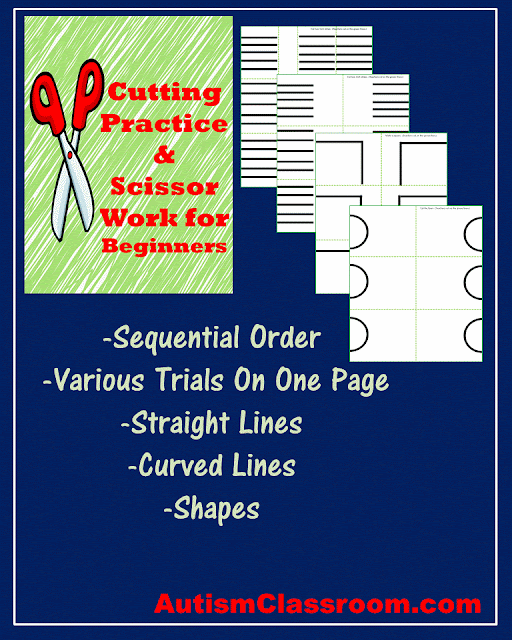
The resource called Cutting Practice and Scissor Work for Beginners provides handouts with sequenced steps for scissor work.  

Most pages contain several trials of the skill on one page.  


The resource also includes lines, curves, and shapes.

                                                     Click for More Information

The steps to cutting the square is broken down into parts.  First, the student will need to cut a straight line to "cut a square" shape. You set it up so that after they finish, they have a square.  Next, you provide them with just an L shaped line, so that after they cut the L-shaped line, they have a square. Third, you give them a square with 3 lines to cut. After they have mastered all of these, you can give them the full square to cut. For some students, this task is easier if you use card stock paper which is not as flimsy as regular copy paper. 

If you need to teach this skill, give these tips a try.  Bring lots of patience. Have fun!


Jul 21, 2015

Fine Motor Skill Sequence for Students Learning Fine Motor Skills

Fine Motor is an area addressed in many general education classrooms and special education classrooms.  There are often a great number of skills kids need when addressing this area. Throughout the years I have provided information  related to a sequential method for addressing fine motor skills. But just last year, I was able to put all of that info together in a uniform and concise package. This is the end result...

Autism, Special Education, Kindergarten- Fine Motor Task Cards


These task cards are for working on fine motor skills.  Each page contains two cards.  The pages can be laminated and them used with dry erase markers or play dough, etc. 

Often, it helps to teach students these skills in a sequenced order.  This is my favorite set of steps that I was taught by an occupational therapist years ago.


Tracing horizontal lines

Tracing vertical lines

Tracing curved lines

Tracing crosses

Tracing slanted lines

Tracing the letters T, V, O, C

These items are all included along with a set of cards without words.


Jul 20, 2015

Setting Up the Special Education Classroom for Success

It is that time of year to start slowly and calmly start thinking about what you want your classroom to look like when school begins...but no pressure here.  It is still summer.  However, it's probably time for me to do a slightly detailed exploration of the book How to Set Up a Classroom for Students with Autism-Second Edition. I say this because, this is the type of information you want to take in a little at a time.


                                                      Click for More Information


The book begins with some information about autism, strengths of individuals with autism, and implications for teaching. This beginning chapter also outlines the 10 main strategies that will be discussed in the book.

What else does it talk about?


First Things First - You need to know that this is a process and will take time. Also, you will need to gather materials and check with your school to see if they have some of those materials.  Most importantly, the First Things First chapter gives about 15 ideas (if you need ideas) for para-professionals on what to do those first few days of school to get the classroom ready.

Why is it unique?


There is a set of discussion questions at the end of each chapter to help if you are using the book for professional development or if you just want to better analyze what you read. Additionally, there is a list on the first page of each chapter that teachers and administrators can use to identify key elements in the classroom.  And, how can I forget, there is a "GAME PLAN" at the end of each chapter to tell you exactly what to do to get started implementing what you have learned.


Want more?


The assessment chapter, of course, describes some assessments that are important for students with significant special needs. The schedules chapter, of course, talks about a variety of schedules. But more importantly, it tells you why to use them. And,  it gives ideas for creating them. The classroom environment chapter provides a detailed checklist and TONS of information about setting up the various area of the classroom. This is my favorite chapter!


Data collection is always a hot topic and it is addressed with a few samples. Those looking for ideas for how to motivate a classroom team, will find it in this book too.  With a behavior support chapter, a sensory chapter and sample templates for routines and lessons, this book always lives up to its nickname "a mentor teacher in a book."  It is available through purchase order at discounted bulk prices at AutismClassroom.com. It is also available online in paperback and electronically at any major book seller, through AutismClassroom.com or through Teachers Pay Teachers- Autism Classroom Store.


Jul 18, 2015

Autism and Special Education Back to School MEGA BUNDLE


Calling all planners and organizers!!!


I am so pleased to announce that it is MEGA BUNDLE time! This Autism &
Special Education Back to School MEGA bundle is a PDF compressed zip file
with 900+ pages. This product contains awesome bundles and products that can help jump start the learning for the school year for students in the early elementary years or students in special education classrooms. All of this in one easy to use product. 


It is only offered aas a mega bundle for a very limited time. After that, the items

will still be offered in the Autism Classroom Store. 


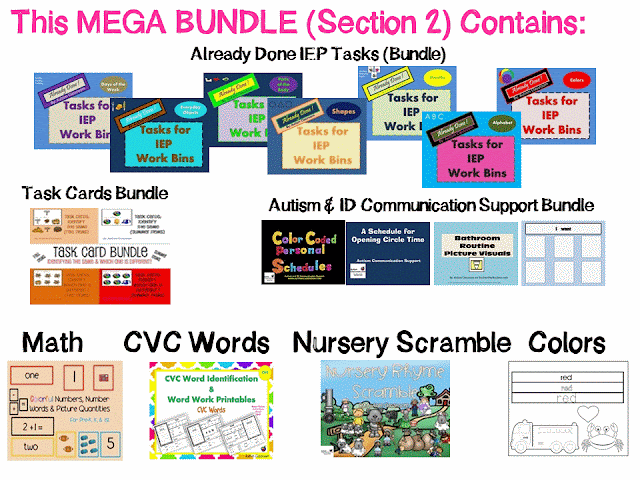
The long list of fabulous items included in the bundle:

Fine Motor Bundle Practice
Morning Work for Students with Autism BUNDLE
Match Rhyming Words Using Pictures
Teens with Autism: Matching, Sorting, Classifying and Identifying
 

Special Education & Autism Interactive Notebook – Play Skills (Part 1)
IEP Work Bin Tasks- Bundle
Same - Different Task Cards Bundle
Autism and ID Communication Support Bundle
Colorful Quantities
CVC Word Identification and Word Work Printables
My Color Book
Nursery Rhyme Scramble 


 Click to see more...
Click on the images to see more.

Mar 22, 2015

Exploring Morning Work for March and April for Students with Special Needs

Finding lessons that are appropriate and meaningful for students is a balancing act teachers deal with each day. Although many teachers love to include morning work activities in the school day, sometimes the task is not suitable for students with autism.  There could be a number or reasons.  For example, maybe handwriting is a challenge or maybe the student cannot handle too many items on the page.  For whatever reason, some worksheets may not work with the student. That is why I am loving these morning work for students with autism packets. 

For one, they may work great for K, 1st and 2nd grade or students whose special needs include developmental delays.   However, they are great for pre-k too.  Secondly, they include printable worksheets that require variations in response styles for many answers.  So if a student is having trouble with writing, they will have options to show what they know without writing.  Some examples include, using string to match items, cutting and pasting answers, using  bingo markers, coloring and circling answers.

There are a number of things I like about the March and April pack.


1. There is a  simple page recognizing Women,s History Month.  This page gives your kiddos practice cutting straight lines and matching to same. 


2. There is a page highlighting the spelling of the work March.  I like it because it focuses on teh work March with easy to do tasks such as using a bingo marker and tracing. 

3. Stepping into April, it has an April Fool's Day page with a joke for students to tell.  They can tell this joke using pictures. Students can point to the picutures to tell the joke if they cannot use words.  This is a great way to introduce the "give and take" skill in conversations and the concept of telling a joke.  How cool it that?


4. And finally, and most importantly, (to me), it talks about Spring! Maybe discussion about Spring will bring the Spring weather.  So, the April Part of the packet covers this.  If you want to discuss Spring and have the students practice cutting and matching pictures to the same picture, then this will do the job. 


Jan 27, 2015

Happy Snow Day!

Hi,

I hope you are warm and safe on this snowy morning. Please take care and stay safe.  

I just remembered about this little treat that is inside my Autism Lesson Printables Winter Edition.  I would like to take a quick minute to share it. There is a really adorable file folder included that is a matching game about Groundhog's Day. It will be discounted today.  I hope it makes your and your students as happy as it makes me.  


Dec 28, 2014

Fine Motor Imitation Skills for Children with Autism

I have been working on materials that address fine motor skills in students.  For some of our students, this can be a real challenge. A few students may have scattered skills in this area.  There is a typical sequence that you can follow to get some motor imitation from your students.  This sequence seems to work: gross motor imitation, fine motor imitation, imitation of nonsense sounds, imitation of animal sounds, imitation of speech sounds and words.  It may be best to chose the skill you want to work on and the materials that you want to utilize. Next, work on that skill using a strong reinforcing item. However, in reality, many children might need guided assistance to correctly imitate a skill. (You don't want them to develop the skill incorrectly- for example writing a letter incorrectly.) Then, you can fade your assistance over time, as they do the skill better and better.

I usually like to have students trace first to have practice with  the actual line or shape.  This tends to be guided practice so that they maintain the correct form and stay on the lines.  I might also include some language with the process such as "Down and stop" or "over and lift up" or whatever cues the student to remember to lift up the writing utensil when the line is done. Additionally, when first starting, I like to place a picture that the student likes at the end of the lines they are writing.  This way,  they are more motivated to finish the line. Once they get to the picture, I say something like "meow" if it is a cat or something fun to keep them motivated.

These Fine Motor Task Cards are great for working on this skill of repeated practice. The tracing cards can be used over and over once laminated.


The Motor Imitation Task Cards and Printables are great to because they come with a set of task cards, but they also have a set of printable worksheets that  allow for 5 trials of  practice of the skill on the same sheet of paper.


Each of these can support the goal of increasing the motor imitation skills in students. But don't forget to add some fun to the task by using some exaggerated sounds and motions as the student learns this task. 


Nov 27, 2014

Dollar Days on Autism Related Teaching Products

Happy Thanksgiving!  

I am happy to announce Dollar Days on my TpT store.  This will be going on today and tomorrow. Ten items have been marked down to one dollar!!!  Enjoy your day.


Sep 7, 2014

Morning Routines in an Autism Classroom

We know that children with autism work better when a routine is established. But 
what makes a good morning routine in your classroom? The truth is that everyone's 
classroom will run differently. I think what is important, however, is that you establish some sort of 
structure to go along with the morning in your classroom. For some of us that involves organizing 
students getting off of the bus and thinking about what do we do after that? Do we go straight to 
breakfast, do we walk down to the classroom?  For each class it would be different. Some routines 
that tend to be standard in classrooms would be students entering the room or entering the space        where their lockers are, removing items from their backpack and placing those items and a 
designated spot. After that, students are most likely expected to find their seats and begin some sort of a morning activity. For some classes this morning activity includes toys or fidgets, and other 
classrooms this morning activity involves work tasks where students need to use their hands to 
manipulate the work task. In other classes, this morning activity may mean worksheets that the 
student is expected to complete. In either case, students will be more successful with completing the routine you establish if you have a visual support. 
 

A visual support is something visual that cues student to show what you want them to do. These 
visual supports can be in the form of pictures icons, photos, or words.  It really just depends on what     works best for the student who needs to understand the information. Use the visual supports as a 
guide for when you are not standing right next to the student; they will still have something to tell them what needs to be done even if you're a few feet away or attending to another student. 
 

I always like the idea of morning work for students just so that they come into school and begin 
 something constructive. I never felt like the students needed a break from the ride into school. 
Now again, this could mean work tasks where students are using their hands to manipulate a task or it could mean some sort of worksheet. Here is an example of my morning work packets related to back-to-school:


The morning work packet has worksheets that require variations in response style 
so that pen and paper are not always needed. They require variations in 
response styles so that writing is not always the only way to provide the 
answer. So for example, some of the response styles might include using string to 
match items, cutting and pasting answers, using bingo markers to provide the 
answer, coloring, making steps in paper, circling answers.